

I Asked 30+ Engineering Leaders at Apple, Amazon, GitHub and Sony What Junior Engineers Should Do About AI. Here's What They Said.
I expected most of the advice to be about AI. Almost none of it was.
A month ago I asked a question on LinkedIn.
If you could give junior engineers one piece of advice, what would it be?
I expected a few replies. Maybe ten, fifteen if I was lucky. What I got was 45 comments from senior engineers, VPs, CTOs and engineering leaders working at Apple, Amazon, GitHub, Sony, HashiCorp, AWS, Barclays, incident.io, Proofpoint and more.
I thought I knew what they’d say. AI is everywhere right now. Junior engineers are scared. Half the headlines tell them their jobs are over. The other half tell them to learn AI or fall behind. So I expected the advice to be about AI.
It wasn’t. Almost none of it was about AI
Today’s sponsor: Luma AI
I used Uni-1 to generate today’s thumbnail. But the news isn’t about thumbnails.
Uni-1 is now an API.
Luma’s reasoning image model - already powering serious creative work in production - is now available as infrastructure. Build it into products, wire it into pipelines, embed it in bespoke tools. Anywhere code runs, Uni-1 can think.
Build with the Uni-1 API → lumalabs.ai/api
#LumaPartner
What they actually said
The first thing that hit me, reading through the responses, was how un-modern the advice was. These people aren’t grandparents. Many of them are building the future. VP of Engineering at incident.io. Field CTO at HashiCorp. Senior SWE at Apple. Staff EM at GitHub. And what they kept telling juniors to do was the same thing senior engineers have been telling juniors for thirty years.
Be reliable. Ask questions. Find a mentor. Don’t burn out. Learn the fundamentals before reaching for shortcuts.
The themes were remarkably consistent.
Be the person other people can count on.
This was the most common theme by a distance. Anyell Cano, Staff Engineering Manager at GitHub, put it in a clean three-pointer:
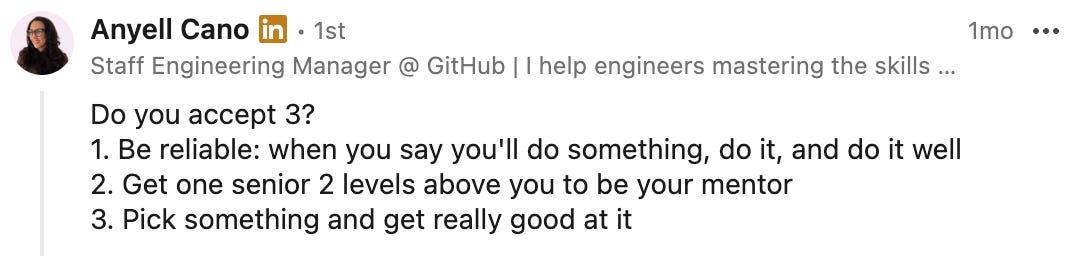
Tehn Yit Chin echoed it almost word for word: “Do what you say you will do. It is an amazing work ethic and it builds trust.”
Dr Milan Milanović , who you’ve probably seen on your feed at some point, given his 300K followers, distilled it to four words: “Underpromise and overdeliver.”
The pattern across these responses isn’t subtle. The senior engineers responding aren’t telling juniors to be brilliant. They’re telling them to be reliable. Brilliance can’t be hired for. Reliability can be earned.
Find a mentor, and don’t always make it your manager.
Matt Syp put it like this:
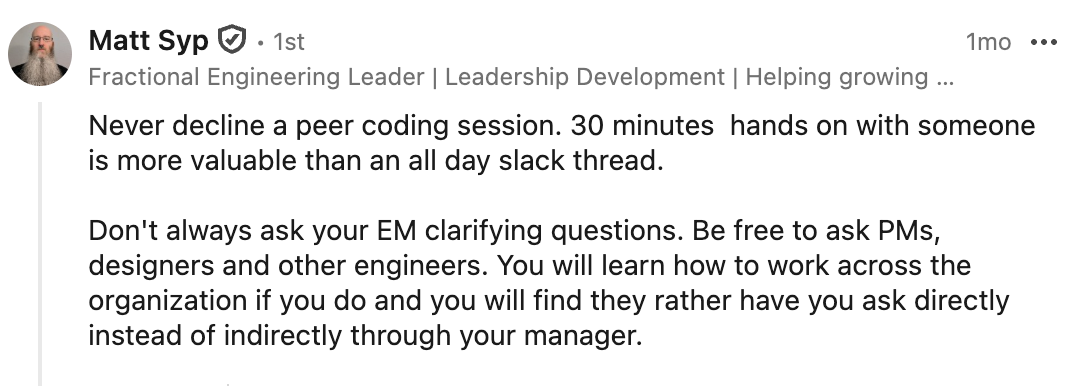
He went further in a follow-up: “Someone telling them it is OK to go around your manager for info. Maybe because some managers are threatened by it, but it is something I always encourage.”
Anyell Cano said it more directly: “Get one senior 2 levels above you to be your mentor.”
This goes against the grain of what most juniors are taught. The chain of command says: ask your manager. The reality, according to people running engineering teams at GitHub, Amazon, and incident.io, is that your manager is one of many people you should be learning from, and often not the most useful one.
Make “why” your most consistent question.
Demitri Swan, Senior SWE at Apple (ex-Google, ex-DigitalOcean), gave one of my favourite lines from the entire thread:

This isn’t a trick. It’s a way of being. The juniors who get ahead aren’t the ones who execute the most tickets. They’re the ones who keep asking why a ticket exists, why the architecture looks that way, why the team made the decision they did. Curiosity compounds.
Jorge Baranda, who’s worked at CrowdStrike, Amazon and Blizzard, added the second half of it: “Do not be afraid to ask for help, ego can get in the way of you learning.”
Asking why and asking for help are the same skill in two contexts. Both are about admitting you don’t know yet. Both are how you get to know.
Now, the AI thread
Here’s where it gets interesting.
The handful of responses that did engage with AI directly were brutal. Not anti-AI. Anti-shortcut. And they all said the same thing.
Robert Ruby II didn’t bother with subtlety:

Nune Isabekyan , a founder building practical AI implementations, said exactly the same thing in lowercase: “same as it has always been - learn fundamentals.”
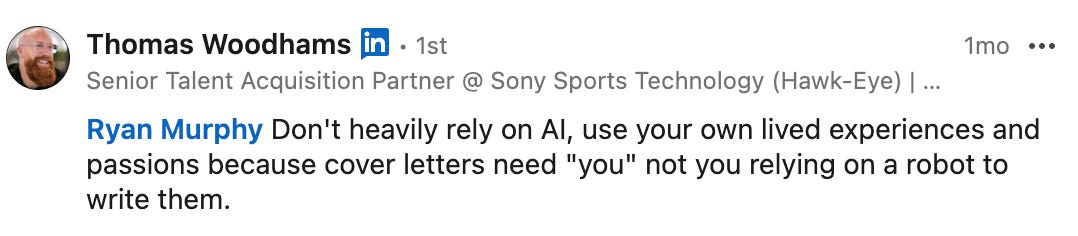
Thomas Woodhams, Senior Talent Acquisition Partner at Sony Sports Technology, brought it to a specific use case juniors actually face:
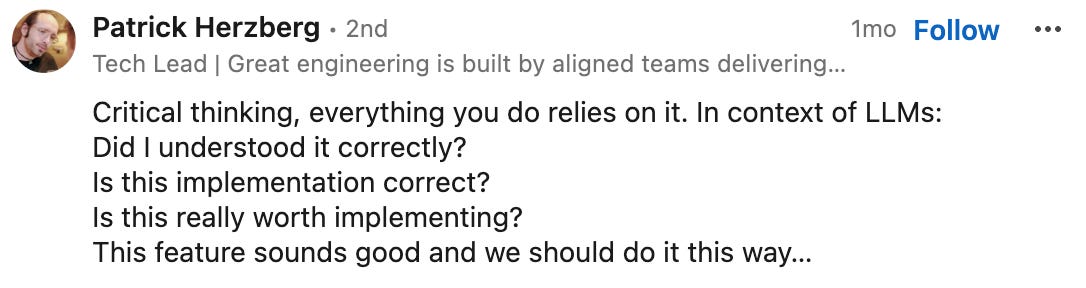
Patrick Herzberg gave the most useful framework I read. Three questions to ask yourself when working with LLMs:
And Brian Jenney offered the smartest practical move in the entire thread: “Identify the strong devs on your team and study them. How do they handle PRs, docs and AI tool usage? Steal what works for them.”
That last one is the key. The senior people answering aren’t anti-AI. They’re anti-shortcut. The advice isn’t don’t use AI. It’s don’t use AI to skip the work that builds your judgment.
You need the fundamentals to know when AI’s output is right. You need critical thinking to question what it gives you. You need senior peers to study so you can see how good engineers actually use these tools.
The AI advice and the rest of the advice aren’t separate categories. They’re the same advice, applied to a new tool.
Closing Thoughts - What I’d tell a junior engineer in 2026
Here’s what I’d say.
The shift to an AI-augmented industry doesn’t change the fundamentals of how you get ahead. It amplifies them.
The juniors who’ll thrive aren’t the ones who learn the most AI tools fastest. They’re the ones who do what they say they’re going to do. Who ask why obsessively. Who find people two levels above them and earn their attention. Who learn the fundamentals deeply enough that they can tell when a tool, any tool, including AI, is producing rubbish. Who protect their energy for the long career, not the short sprint.
That’s not new advice. It’s the oldest advice in engineering. And in 2026, it matters more than ever, because the noise around shortcuts has never been louder.
The leaders responding to my post aren’t telling juniors that AI doesn’t matter. They’re telling them something subtler. AI is a tool. Tools amplify whoever uses them. If you’ve built the judgment to use it well, AI will multiply your impact. If you haven’t, it’ll multiply your mistakes.
The work that builds the judgment is the same work it’s always been.
If you found this useful, the people I quoted deserve a thank you. They didn’t have to take time to answer a stranger’s question on LinkedIn. They did it anyway. That’s the kind of generosity that built the engineering community in the first place.
Here’s a link to the LinkedIn Post.
Ryan
Most engineering managers are thrown into the role and left to figure it out alone. No training. No community. No one to ask.
That’s why I built EM Accelerator. 7 self-paced modules, a private community, monthly office hours, direct access to me, expert interviews, worksheets, and lifetime updates. Everything an EM actually needs, in one place.
The first 25 founding members get founder pricing. Get on the waitlist. The waitlist IS FREE.
Liked this, even a tiny bit or feel sorry for me? Make sure to click the like button ❤.
Think someone else might find this useful or you just want to make fun of me together? Make sure to share this post 🔗.
Want to write a guest post for this newsletter? Let me know!
The FREE waitlist for my new premium training platform for Engineering Managers is now live.
I’ve launched a new YouTube channel.
Check me out on LinkedIn. I’m at >58,000 followers now.
Nice summary and thanks for the mention! It's uncertain time for many, and it's important to not fall into the hype and focus on what matters in the long run.
The "AI amplifies whoever uses it" framing is the right one. The juniors I see pulling ahead aren't the ones racing to master every new tool, they're the ones with enough fundamentals to recognize when an LLM is confidently wrong. AI doesn't replace judgment, it just makes the absence of it visible faster.